- How old are you? 20. Wow, really ?! I'm a baby compared to most of my friends but at the same time, 20 YEARS, that's a long time !
- Who's your favorite singer? Shawn McDonald.
- Would you rather text or e-mail? The obvious answer is that it depends. Right now, the immediacy of texting seems really appealing but e-mail tends to be more conducive to expressing what you're feeling or thinking.
- Do you have any pets? Yep, a dog, cat, and several fish back home.
- Do you have an Ipod? Yep.
- Do you love to sing? Yep, LOVE to!
- What's your favorite song in the whole world? Currently, “Open Wide” by Future of Forestry
- Do you have your own room? Currently and at home, yes.
- What is the color of your room? At home, pale/light green and bluish lavender.
- What's your favorite hobby? Kayaking
- If you could be a prodigy in any one thing, what would it be? Dance (just for the heck of it). It's been a secret goal of mine that I haven't worked on at all really.
- You're going to a desert island and get to take 3 albums with you. Which 3? Simply Nothing by Shawn McDonald, 21 by Adele, The Best of U2
- If you could (only) eat one food for the rest of your life, what would it be? This delicious salad my host mom makes (parsley, mint, lettuce, tomatoes, shredded carrots, sautéd onions with sugar, potatoes, mustard-y sauce) with baguette.
- And now I get to add one: A quote or piece of advice to live by: You're accountable for what you know. - Prof. Majeed
Friday, April 27, 2012
nu dem! - let's go!
So, my blog post have been, well, on Dakar time. To get the ball rolling, here's a short one that my friend tagged me in on her blog. Some responses are Senegal related...

Friday, April 13, 2012
C'est la vie
It have several final papers/presentations due the beginning of next week so finishing up and posting blog entries has taken a back seat. C'est la vie. So, here are some of the everyday reminders that have been significant to my time here.
This sigh is less than a block away from my house. It reads "You (plural/formal) don't have (the) priority." There are so many ways to understand that sentence.


The Baobab Center has quotes posted throughout the center. These two have particularly stuck with me.


Wednesday, March 28, 2012
Lekkal! Eat!
This blog post has been in the works
for quite some time and I'm sure there is much more I could add, but
I haven't posted anything in a while (sorry about that), so here's a
glimpse into what I've learned about food in Senegal so far. Please
ignore typos and incomplete thoughts – I posted this in a rush.
Before coming to Senegal, I was a
vegetarian. I hadn't eaten fish or red meat by choice in at least
five years. I was a convenience vegetarian, not in the sense of
whether or not being vegetarian was convenient for me but whether or
not it was convenient for others. If everyone else wanted pepperoni
pizza for example, I was fine just picking the pepperoni off or just
eating it if picking it off wasn't appropriate. Last fall, when I was
filling out the information sheet for my future host family, I chose
not to mention being a vegetarian. I decided as I was filling out
that form that my vegetarian-ness was not that important to maintain
while here. I also knew, even at that point, that it is not easy to
be vegetarian in Senegal.
I've eaten fish, beef, chicken, sheep,
and probably several other animals while I've been here. I just don't
ask about the meat. There are dibiteries (butchershops, though
butcher stands is more descriptive) in every neighborhood. There are
a few streets in my neighborhood lined with women cutting and selling
fish. Interspersed between the fish stands are vegetable stands
selling the standard veggies used in Senegalese cuisine: tomatoes,
bitter tomatoes, carrots, something like cabbage, pumpkin, eggplant,
potatoes, and another starchy vegetable. From what I know, these are
the primary places where Senegalese get their produce. Likewise,
there are a few boulangerie stands in every neighborhood which
provide for the baguette needs of the community. Supermarkets are few
and far between, and much smaller than ones back in the states (think
the size of a fast food restaurant). Produce, fish, and bread are
largely absent. Who needs a supermarket when there are boutiques that
have small quantities of pretty much anything you'd need?! Each
family has their “regular” boutique. Parents will send their kids
to the boutique to buy certain things and to teach them about their
involvement in the family.
A few weekends ago, I had a
conversation with Mariam (my host sister) and Laci (the American who
stayed with my host family several years ago and is now living with
her Senegalese husband and teaching English) about eating meat. Laci
is also a vegetarian. While Mariam doesn't particularly like meat,
she couldn't wrap her mind around why Laci and I chose not to eat
meat at all. After mentioning not liking the texture of meat and a
few other things, Laci talked about the difference in proximity to
the animals we eat. Here, it is fairly normal to see sheep around, to
see people selling live chickens, for people to go fishing to catch
dinner. People kill animals themselves for religious celebrations.
I've known of several times this has happened since I've been here,
though thankfully non have happened in my backyard. Animals live good
lives here, and people have respect for the quality of the animal's
life. Contrast that to the commercial meat industry in the US.
One of the biggest differences about
eating here is that many people eat from one large dish (for lunch
and dinner). I LOVE THIS, for the most part! Each person eats from
their figurative “piece of the pie” but the meal is still deeply
communal. The seating situation varies from family to family.
Traditionally, women and men eat in separate areas, sit on a floor
mat with the dish in the middle, and eat with their hands. Cutlery is
overrated, overemphasized, over-idealized in Western culture. My
family eats around a small coffee table, either outside or inside,
depending on the weather. Some of us (usually my dad, brothers, and
I) sit in plastic chairs while any others sit on small wood stools
(my family only has 4-5 chairs). Mariam usually eats separately, and
usually makes a baguette sandwich of whatever the meal is. When my
host mom is home, she is usually the one who prepares the meal. When
she's not, one of my female host cousins who is about my age prepares
the meal. I don't know if they're actually related to my host family,
but my family interacts with them as if they are. It is very common
for Senegalese households to employ a young woman who cooks and
cleans, a “bonne” in french. The kitchen is very much the woman's
domain, and many men don't step foot in the kitchen and often don't
know how to cook.
Another aspect of the meal that is very
much the woman's role (as the mother or hostess) is distributing the
food within the communal dish. Rice is spread throughout the dish but
the fish and veggies (or other meat or appetizing things) are in the
middle. Traditionally
“Neex naa lool!” (It's very
delicious!)
I realize I've gotten this far in the
post and still have yet to describe the food itself.
Breakfast: baguette, butter, tea.
Sometimes chocolate spread.
Lunch (usually between 1:30 and 2:30
pm): always rice, usually with fish, almost always a traditional
Senegalese dish
mafe: white rice
with a peanut based sauce
ceebujin: red-ish
oily rice (due to tomato based sauce) with fish and veggies
(I forgot the
name): brown rice with meat gumbo
Dinner (usually between 8:30 and 9:30
pm): varies: often pasta dish, sometimes rice dish, sometimes
couscous dish, sometimes salad dish (my favorite!!!)
Lunch is the main meal of the day;
dinner is a light meal.
“Kay añ!”(Come,
eat lunch!) My family normally eats lunch rather early. Somedays I
head back to the Baobab Center right after lunch and in doing so, I
see others just beginning to gather themselves for lunch, including
some of the Baobab Center staff. “Kay añ!”
they say to me, genuinely. Lunch is a plentiful meal, and the
mentality of “no ko bokk” (we share it) applies to the meal. It
is not just something to be shared with family but with friends and
anyone who might come by, whether or not you know them). It is an act
of hospitality to share a meal.
“Suur naa!” (I'm full!)
There are still days when my host
family doesn't believe me when I say I'm full. “Lekkal, lekkal”
(eat! Eat!), they ALWAYS say. Again, sharing a meal is an act of
hospitality and it's important that guests are satisfied. The Baobab
Center staff warned us that losing weight while here is seen as a
slight disgrace by the host family.
People generally buy smaller quantities
more frequently. One possible explanation is that higher levels of
poverty means less flexibility with money.
Last week was spring break, and the
other Beloit girls and I traveled to a few villages in the
south-eastern part of Senegal. (I'll blog about it soon.) When we
were asked what we wanted to eat for meals, the locals were
pleasantly surprised that we were way more excited about eating
traditional Senegalese dishes than the more western options like
spaghetti.
Senegalese food is delicious and it has
been an adventure to learn to eat like Senegalese do. I will
certainly be bringing some aspects of the Senegalese attitude toward
food and meals back with me to the states. Look forward to it!
 |
| Oh, we made ceebujin the other weekend. Neex naa looooool! This is an example of one bowl that 5-8 people will sit around and eat together. |
 |
| Fish! |
Saturday, March 3, 2012
Rafet na! - It's beautiful!
Last weekend was the Senegalese presidential elections. My family and I spent most of the day in our backyard relaxing, playing, and cleaning the sheep. In the evening, we watched the TV as the votes were provisionally reported from different voting stations and regions. Officials from each voting station called in to the TV station and the call was broadcast live. Between phone calls, they showed footage of people standing in line to vote, picking up ballots, dropping them in the box of votes (for lack of a better word), and of officials counting votes. Watching democracy in action was beautiful. Especially because many of the voting stations were schools, especially because the vote counts were written on blackboards in Senegalese cursive, especially because the weekend had been peaceful.
Here's some of the beauty of that
weekend:
 |
|
The photographer, 6 year old Papito (a
family friend).
|
 |
|
My host mom and brothers (Moctar and
Mohammad) preparing to wash our sheep. If you think giving a dog or
cat a bath is hard and/or amusing, washing sheep is even more so.
|
 |
|
Step #1: Tie the sheep to a cement
brick so they can't run away. (Essential step)
|
 |
|
One of my favorite pics. Teamwork!
|
 |
|
My host sister, Mariam. She is
beautiful, period. Over the course of the day, several child cousins
and family friends came over (while their parents went to vote?).
Watching her play with them and play mother to them in some ways was
beautiful.
|
 |
|
Possibly my favorite picture. Notice Mariam
giving Papito bunny ears.
|
 |
|
A beautiful moment.
|
 |
|
An even more beautiful moment.
|
Friday, February 24, 2012
Ak xam xam – With knowledge
Last
Wednesday in my Wolof class, the professor passed out a
worksheet that he'd quickly thrown together that morning. The other
Beloit girls and I have taken to referring to the worksheets he gives
us for homework as “des cadeaux” (gifts) after he jokingly
referred to our first worksheet as such. If he hasn't given us a
worksheet by the end of class, we often give him a little grief about
not having a gift to give us.
That day, the “cadeau” was not for
homework but rather for us to discuss in-class in Wolof.
Among the
questions:
What is the
usefulness of education for humanity?
Seeking money or
seeking knowledge, which is more importance? Why?
Is the lie that
repairs better than the truth that destroys?
As we discussed the
first two questions, we repeated the phrase “ak xam xam” (with
knowledge) several times.
Ak xam xam, men na
an liggey (one can have work)
Ak xam xam, men na
waxtaan ak nit (one can talk with humanity)
Ak xam xam, men may
ay lejaasa (one can give diplomas)
Ak xam xam, one
develops oneself, a society develops.
Ak xam xam, men may
xam xam (one can give knowledge)
What is knowledge? What is truth?
You are accountable for
what you know. -Prof. Majeed
“Give
knowledge”
The education
system here is significantly different than the education system in
the states. I could rattle your ears off with all the differences
I've noticed but I for now I'll focus on just one: Knowledge is
primarily something that you receive, not obtain. Libraries are often
sparsely equipped and the internet is not widely or easily
accessible. If you have a question, you don't “google” it, you
ask a teacher. The other Beloit girls and I have noticed that the
difference between the way many of the Baobab Center professors teach
and the way many Beloit professors teach reflects this different
perception of knowledge. At Beloit, much emphasis is placed on
learning how to learn and exhibiting critical thinking. At the Baobab
Center, the emphasis seems to be placed on understanding what the
professors are teaching us, regardless of whether or not they are
supporting the statements they're making. Granted, part of that
emphasis is because the classes are held in French. Adjusting to this
different way of learning is frustrating at times because my brain is
so wired to question the information that is presented to me and to
support the statements I make. Despite this frustration, I am
grateful for the “insider” knowledge and insights our professors
have given us. They have given us the gift of knowledge that we
likely wouldn't have received otherwise.
If knowledge is
power, when you give knowledge, you also give power.
For everything that
I have learned in the classroom, I have learned leaps and bounds more
outside the classroom. The notion of “informants” in social
science field work – people within the culture informing you
about the culture through your interactions- seems very true here and
is much easier to see than back in the states.
I've heard it said
that people come into our lives for a reason, bringing something we
must learn. And we are led to those who help us most to grow if we
let them and we help them in return. - "For Good" from Wicked
Philosopher Jacques Maritain: the
culmination of knowledge is not conceptual but experiential.
If knowledge is
power, when you give knowledge, you also give power.
Empire des Enfants
Addie, Val, and I
have started teaching English at Empire des Enfants, a home for boys
rescued from the streets of Dakar. Our partnership with them has so
far been a roller coaster of eagerness, conviction, overwhelm,
optimism, anxiety, different standards of communication, passion,
frustration, creativity, and courage. Several times, we have
questioned our involvement with the organization: What are the
appropriate ways for us to help the organization? Are we causing
harm? (Are we doing more harm than good?) What should we be teaching?
Amid all the questions and thoughts, I was struck by the fact that
knowing English is an incredibly valuable skill, a privilege, a gift.
Who am I to keep it to myself?
You're accountable
for what you know.
If knowledge is
power, when you give knowledge, you also give power.
Education is definitely a ladder between social classe
Education is definitely a ladder between social classe
All this about
knowledge, what about truth? How are they connected? The same?
Different?
So many thoughts!!!
 |
| This was a picture I took at a street school we visited within the first few weeks. The words read: We would like for all children to be able to go to school, especially the girls. |
Saturday, February 18, 2012
Ode to Falling Down
Today I went on a run for the first
time since arriving in Dakar almost six weeks ago. Surely you have a
sense of how that went from the title of this post. It was an amazing
run though! I started in my neighborhood and fell soon after the
sidewalk changed from hard sand to cobblestone. Uneven ground and not
having run in a long time is apparently not a good combination. I
took my first tumble within the first 15 minutes, right as a taxi was
driving past me. Perfect. The driver kindly reminded me to remember
my cell phone which was now a few feet in front of me. After checking
the damage done – a nice purple bruise on my hip and a slightly
scraped up calf, I decided to walk/jog to the Baobab Center and use
the mirrors there to check that there weren't any injuries I couldn't
see. A few minutes later I passed the same taxi parked on the side of
the road. The driver asked to make sure I wasn't hurt. I assured him
I was fine and thanked him for his concern.
About 10 minutes later, I fell again.
This time, I was on the sidewalk next to a split highway, 6 lanes
total. Way to go me! I eventually made it to the beach, my goal this
entire time. Once I got there, I started running the length of the
beach (which wasn't that long). There were three young men also
running the length of the beach, which is nothing compared to the
amount of men who work out on the beach later in the evening. Running
on the sand was a new experience for me so I'm sure I looked a bit
ridiculous but the guys were nothing but positive. The first time I
passed the two that were running together in the opposite direction,
one said “run well” (in French). Second time: Go! Go! Go! (in
English). I took a short break and when I started again, he asked
“why did you stop?” “It's my first time.” “Ahh (in an
understanding tone).” Our next interaction: Keep running! (in
French). Way to be awesome!
Sand is forgiving; that is the perfect word to describe what I learned from running on
the sand f.
Alxamdulilaay
(Thank God) that forgiveness has met me most of the times I've
stumbled or fallen down in cross-cultural interactions, in
friendships/relationships, and in faith.
So here is my musical ode to falling
down:
All Fall Down – One Republic
Falling Slowly – Glen Hansard (such a
good song!)
Let Me Fall - Josh Groban
Dare You to Move - Switchfoot
Honorable Mentions:
After I Fall – Lee Ann Womack
Falling Down - Clear
Lift Us Up to Fall – Tenth Avenue
North
Fallen – Vib Gyor
Break Me Down – Tenth Avenue North
We Fall Down - Chris Tomlin
Monday, February 13, 2012
Fan mangi dem? - Where am I going? (Being directionally oriented)
Sorry it's been a while since I've
written a post. I have several that are almost finished in my mind that I
just need to type up. Hopefully I'll be able to post them this week and
they'll make up for my lack of posts.
I have a pretty good sense of
direction, but context is everything. Back in the states, some
people use street names and others use land marks to orient
themselves geographically. Here in Senegal, there are street names
but nobody knows them. The houses and businesses are numbered but
there is no order to the numbering. Addresses consist solely of the
neighborhood and house number. Senegalese people don't rely on maps
like we do in the US, they rely on people. If they don't know where
something is located, it's completely normal to ask people along the
way. There's no stigma associated with asking for further direction.
In one of the classes I'm taking, Dakar
in Transition, we're learning about the city of Dakar through a
combination of historical, geographical, sociological, and
anthropological lenses. One of our first assignments was to make a
map/drawing of the route we walk between our houses and the Baobab
Center. When we shared them in class, a few themes were evident. We
had only included the names of the very large streets. (While all the
streets in our area are marked with a name and/or number, the
markings are rather discrete and nobody pays attention to them.) We
noted the locations of the houses or businesses of some of the people
we regularly pass by: neighbors, family friends, women and men we
greet at the boulangerie, fruit, or coffee stands. If I were to draw
a map of the neighborhood I live in back in the states, either while
at Beloit or while home in California, it would look significantly
different. To say the least, the “landmarks” would be buildings
and street names, not people.
A few thoughts on that:
- The speed of transportation. In
Senegal, I walk almost everywhere. I experience the area from the
perspective of a pedestrian. Especially when I am back home in
California, I am in a car for the majority of the time I spend going
through my neighborhood.
- The organization of space and the
nature of business. Both here and back home, I pass by businesses
when going from one place to another. Back home, they are generally
inside big buildings and interactions are impersonal. Here, the
businesses I pass are small corner stores, hole in the wall tailor
shops, meat shacks, and food stands. Interactions are lengthy and
personal.
Our professor also asked us to orient
the maps on a broader level by identifying the direction of North. I
got it on my second try. While we'd thought our maps were oriented
compatibly, we were off because our perceptions of the direction of
several main roads were off. Our sense of direction was off because the things we were basing it on had given us a false sense of direction.
On Friday, I saw one of the most
beautiful social occurrences I've ever seen. It was 14:00 (2 pm) and
the call to prayer had just begun. I began my walk back to the Baobab
Center earlier than usual. My host brother had left just before me
and as I closed the gate, I caught a glimpse of where he'd gone. Men
and boys lined the street with their prayer mats in front of them. A
few others were quickly joining them. They were all facing the same
direction, towards Mecca, as they are supposed to. Now that's some
sense of direction, geographically and spiritually.
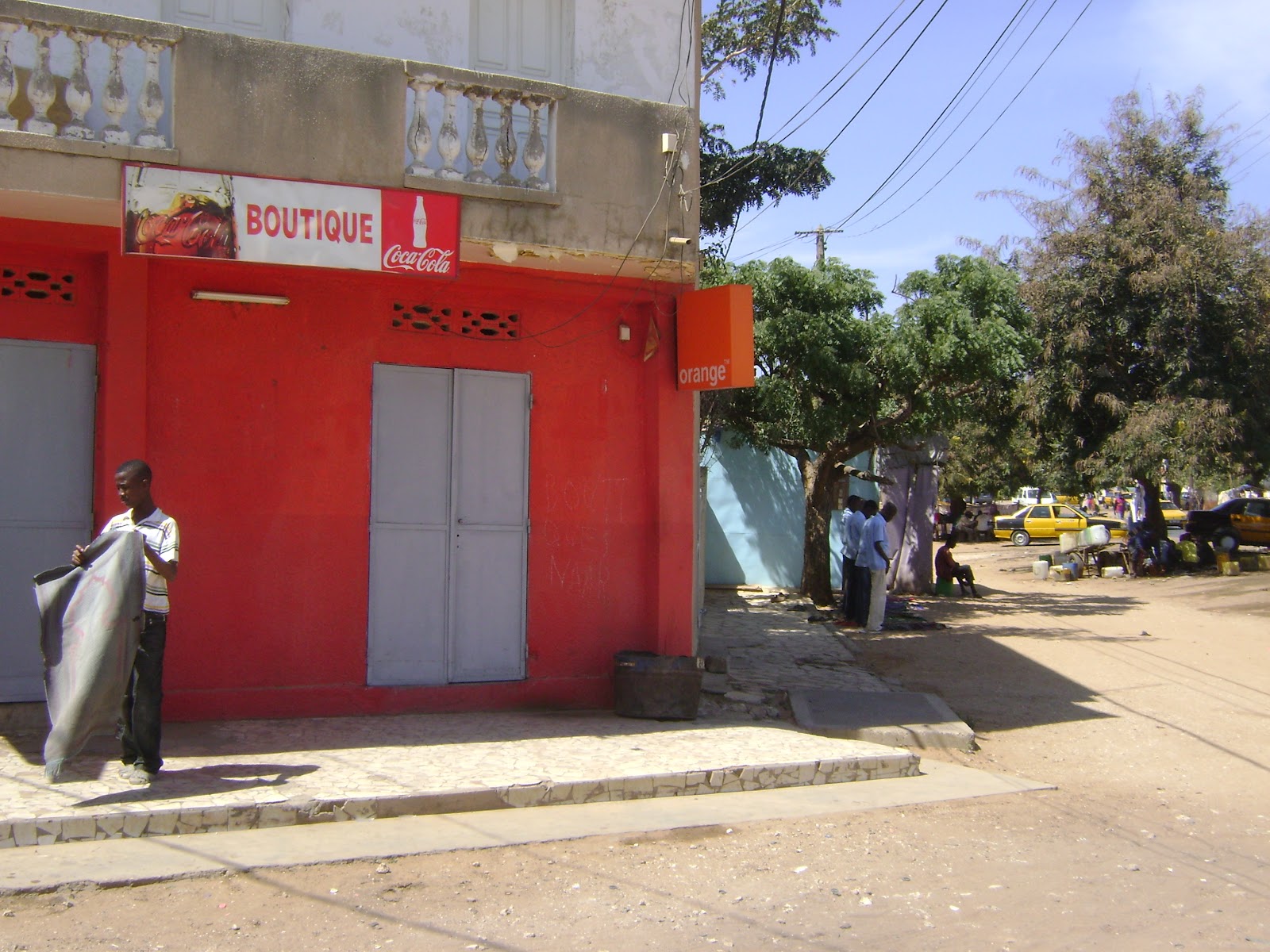 |
| It's Friday 14:00 (2 pm). The boutique, like many other businesses, is closed. My host brother is among the several men praying in a line in the shade made by the building. |
 |
| I could see men praying in line as far down the street as I could see. (I felt so bad taking this picture because they're praying but I really wanted to capture this moment.) |
 |
| On the plane ride here, there were individual TV screens in the seat backs. I occasionally checked the "Map/Flight Info" and this was one of the screens in the rotation: The direction and distance to Mecca. |
This has been a long post, surprise
surprise, but I want to make one more connection. Sense of direction
also applies not only to geography but also to time. In the months
before arriving in Dakar, I had a strong sense of how much time was
left before I would be in Senegal. I have been here for just over
five weeks. I have just under three months left of being in Senegal
with the study abroad program. I will be back in the states in three
months. Those last three sentences correspond to three different
mindsets of understanding the time I have here (insh'allah) and the
mindset that I have greatly impacts how I spend my time and how much I invest into relationships here and in the US.
The future is creeping up on me in
multiple regards. I've made decisions about how I will spend my time
this summer and senior year. Each decision changes the direction in
which I'm headed to some degree.
The playlist that goes along with this, in case you're curious,
includes:
- A LOT of Switchfoot: Gone, Meant to
Live Dare You to Move, Red Eyes, This is Your Life
- “Divine Intervention” by
Autopilot Off
- “Wide Open Spaces” by the Dixie
Chicks
- “Sidewalks” by Story of the Year
- ”Little Wonders” by Rob Thomas
- “From the Inside Out” by Hillsong
- “Lifesong” by Casting Crowns
- “Take this Life” by Shawn
McDonald
- “Move Along” by The All-American
Rejects
- “I Hope You Dance” by Lee Ann
Womack
- “These are Days” by 10,000 Maniacs
- “God is a DJ” by P!nk
- “Kids” by MGMT
- “All at Once” by Jack Johnson
- “Good Life” by OneRepublic
- “Tension & Thrill” by
Sleeping at Last
I have a pretty good sense of
direction, but context is everything.
Subscribe to:
Posts (Atom)