Saturday, February 18, 2012

Ode to Falling Down


Today I went on a run for the first time since arriving in Dakar almost six weeks ago. Surely you have a sense of how that went from the title of this post. It was an amazing run though! I started in my neighborhood and fell soon after the sidewalk changed from hard sand to cobblestone. Uneven ground and not having run in a long time is apparently not a good combination. I took my first tumble within the first 15 minutes, right as a taxi was driving past me. Perfect. The driver kindly reminded me to remember my cell phone which was now a few feet in front of me. After checking the damage done – a nice purple bruise on my hip and a slightly scraped up calf, I decided to walk/jog to the Baobab Center and use the mirrors there to check that there weren't any injuries I couldn't see. A few minutes later I passed the same taxi parked on the side of the road. The driver asked to make sure I wasn't hurt. I assured him I was fine and thanked him for his concern.

About 10 minutes later, I fell again. This time, I was on the sidewalk next to a split highway, 6 lanes total. Way to go me! I eventually made it to the beach, my goal this entire time. Once I got there, I started running the length of the beach (which wasn't that long). There were three young men also running the length of the beach, which is nothing compared to the amount of men who work out on the beach later in the evening. Running on the sand was a new experience for me so I'm sure I looked a bit ridiculous but the guys were nothing but positive. The first time I passed the two that were running together in the opposite direction, one said “run well” (in French). Second time: Go! Go! Go! (in English). I took a short break and when I started again, he asked “why did you stop?” “It's my first time.” “Ahh (in an understanding tone).” Our next interaction: Keep running! (in French). Way to be awesome!

Sand is forgiving; that is the perfect word to describe what I learned from running on the sand f.

Alxamdulilaay (Thank God) that forgiveness has met me most of the times I've stumbled or fallen down in cross-cultural interactions, in friendships/relationships, and in faith.

So here is my musical ode to falling down:

All Fall Down – One Republic
 Get Back Up (TobyMac)
 Falling Slowly – Glen Hansard (such a good song!)
Let Me Fall - Josh Groban
 Dare You to Move - Switchfoot
Everything Falls - Fee
Fallen - Sarah MacLachlan

Honorable Mentions:
After I Fall – Lee Ann Womack
Falling Down - Clear
Lift Us Up to Fall – Tenth Avenue North
Fallen – Vib Gyor
Break Me Down – Tenth Avenue North
We Fall Down - Chris Tomlin

Monday, February 13, 2012

Fan mangi dem? - Where am I going? (Being directionally oriented)

Sorry it's been a while since I've written a post. I have several that are almost finished in my mind that I just need to type up. Hopefully I'll be able to post them this week and they'll make up for my lack of posts.

I have a pretty good sense of direction, but context is everything. Back in the states, some people use street names and others use land marks to orient themselves geographically. Here in Senegal, there are street names but nobody knows them. The houses and businesses are numbered but there is no order to the numbering. Addresses consist solely of the neighborhood and house number. Senegalese people don't rely on maps like we do in the US, they rely on people. If they don't know where something is located, it's completely normal to ask people along the way. There's no stigma associated with asking for further direction.

In one of the classes I'm taking, Dakar in Transition, we're learning about the city of Dakar through a combination of historical, geographical, sociological, and anthropological lenses. One of our first assignments was to make a map/drawing of the route we walk between our houses and the Baobab Center. When we shared them in class, a few themes were evident. We had only included the names of the very large streets. (While all the streets in our area are marked with a name and/or number, the markings are rather discrete and nobody pays attention to them.) We noted the locations of the houses or businesses of some of the people we regularly pass by: neighbors, family friends, women and men we greet at the boulangerie, fruit, or coffee stands. If I were to draw a map of the neighborhood I live in back in the states, either while at Beloit or while home in California, it would look significantly different. To say the least, the “landmarks” would be buildings and street names, not people.

A few thoughts on that:
- The speed of transportation. In Senegal, I walk almost everywhere. I experience the area from the perspective of a pedestrian. Especially when I am back home in California, I am in a car for the majority of the time I spend going through my neighborhood.
- The organization of space and the nature of business. Both here and back home, I pass by businesses when going from one place to another. Back home, they are generally inside big buildings and interactions are impersonal. Here, the businesses I pass are small corner stores, hole in the wall tailor shops, meat shacks, and food stands. Interactions are lengthy and personal.

Our professor also asked us to orient the maps on a broader level by identifying the direction of North. I got it on my second try. While we'd thought our maps were oriented compatibly, we were off because our perceptions of the direction of several main roads were off. Our sense of direction was off because the things we were basing it on had given us a false sense of direction.

On Friday, I saw one of the most beautiful social occurrences I've ever seen. It was 14:00 (2 pm) and the call to prayer had just begun. I began my walk back to the Baobab Center earlier than usual. My host brother had left just before me and as I closed the gate, I caught a glimpse of where he'd gone. Men and boys lined the street with their prayer mats in front of them. A few others were quickly joining them. They were all facing the same direction, towards Mecca, as they are supposed to. Now that's some sense of direction, geographically and spiritually.

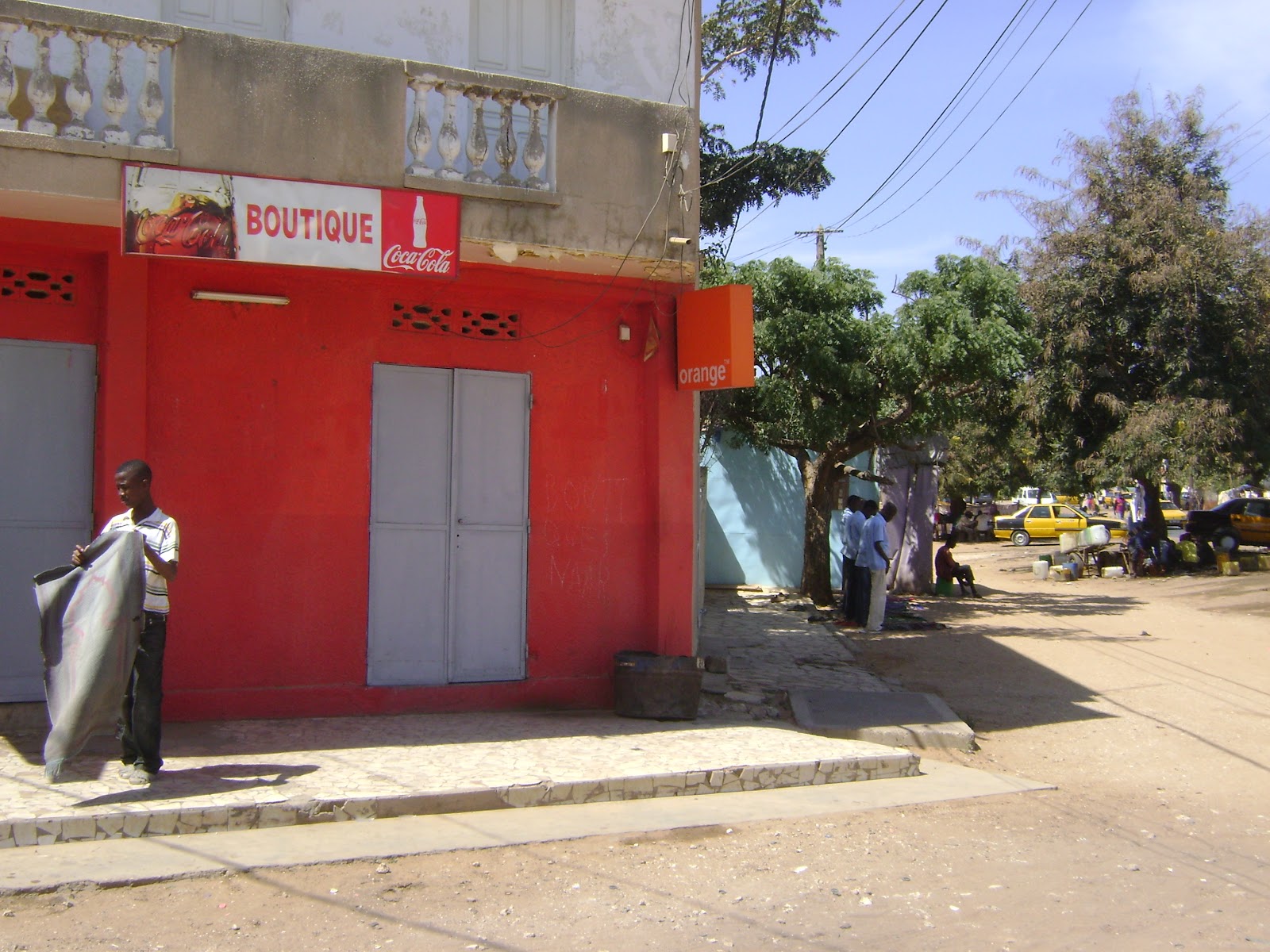
It's Friday 14:00 (2 pm). The boutique, like many other businesses, is closed. My host brother is among the several men praying in a line in the shade made by the building.
I could see men praying in line as far down the street as I could see. (I felt so bad taking this picture because they're praying but I really wanted to capture this moment.)
On the plane ride here, there were individual TV screens in the seat backs. I occasionally checked the "Map/Flight Info" and this was one of the screens in the rotation: The direction and distance to Mecca.
This has been a long post, surprise surprise, but I want to make one more connection. Sense of direction also applies not only to geography but also to time. In the months before arriving in Dakar, I had a strong sense of how much time was left before I would be in Senegal. I have been here for just over five weeks. I have just under three months left of being in Senegal with the study abroad program. I will be back in the states in three months. Those last three sentences correspond to three different mindsets of understanding the time I have here (insh'allah) and the mindset that I have greatly impacts how I spend my time and how much I invest into relationships here and in the US.

The future is creeping up on me in multiple regards. I've made decisions about how I will spend my time this summer and senior year. Each decision changes the direction in which I'm headed to some degree.

The playlist that goes along with this, in case you're curious, includes:
- A LOT of Switchfoot: Gone, Meant to Live Dare You to Move, Red Eyes, This is Your Life
- “Divine Intervention” by Autopilot Off
- “Wide Open Spaces” by the Dixie Chicks
- “Sidewalks” by Story of the Year
- ”Little Wonders” by Rob Thomas
- “From the Inside Out” by Hillsong
- “Lifesong” by Casting Crowns
- “Take this Life” by Shawn McDonald
- “Move Along” by The All-American Rejects
- “I Hope You Dance” by Lee Ann Womack
- “These are Days” by 10,000 Maniacs
- “God is a DJ” by P!nk
- “Kids” by MGMT
- “All at Once” by Jack Johnson
- “Good Life” by OneRepublic
- “Tension & Thrill” by Sleeping at Last

I have a pretty good sense of direction, but context is everything.

Wednesday, February 1, 2012

Jamm? - Peace? (The political situation in Senegal)


This time last year, I knew very little about Senegalese politics. Like most of you, I was content just knowing that it has a stable democratic government and hadn't been in the headlines for political unrest or rebellions. In the past three and a half weeks, Senegalese politics have become immensely important to me.

So why do I feel the need to write a blog post about Senegalese politics? Well, because the times they are a changin' and events in the past few days have attracted international attention. I don't want you to worry unnecessarily, I find it all pretty interesting, and it has certainly shaped my experience here.

The essentials:
  • The Senegalese presidential election is at the end of this month (Feb. 26) and has become increasingly controversial. Various branches of the government have acted in questionable ways and Senegalese people want to keep the government accountable to maintaining a fair and transparent democracy. So far the protests have been mostly peaceful. The ones that have been a bit more violent are farther from Dakar.
  • This is all happening at least a 40 minute walk away from where I live and go to school. (We walk everywhere here so that's the way I measure distance.) I'm not seeing this with my own eyes, I'm reading about it in the papers etc.
  • It's very unlikely that anything serious will happen. Nothing at all comparable to Egypt or Libya. Think more along the lines of the Madison protests or the Occupy movements.
  • I am absolutely fine, and am in the best hands possible should something happen.
If you're curious, here's the basics:
  • The incumbent, Abdoulaye Wade, is atleast 85 years old and has been in power since 2000. He has declared himself as a candidate for this election, which would be his third term in office.
  • After he became president in 2000, he made some changes to the constitution, including setting a two-term limit. After winning the 2007 election, Wade said he wouldn't run in 2012.
  • In 2009, Wade tried to create the unelected position of Vice President with the underlying intention to name his son to the position and thus create a easy and legal way to maintain power.
  • In June 2011, Wade tried to make additional constitutional changes that would make his reelection in 2012 easier. Cue protests, Wade withdraws intended reforms.
  • Cue organization of opposition into “M23.”
  • The past weekend, the Conseil Constitutional judged the legitimacy of the Wade's candidacy as well as all other candidates. Almost all Senegalese and foreign scholars of constitutional law held the position that Wade's candidacy was unconstitutional.
  • The Conseil Constitutional however ruled that it was constitutional. Definitely some hints of bribery and corruption.
  • Throughout the weekend and again today, there have been protests and rallies in Dakar and other big cities in Senegal. Civilians and police have both been injured and a few have died. The gendermarie (which as far as I understand is a special police force for the executive branch) have gotten involved and have acted preemptively.
  • M23 has plans to continue putting pressure on Wade and the current government. (They want Wade to withdraw his candidacy).
How this has impacted my experience:
  • Class was cancelled this afternoon. My host siblings had the day off.
  • I've been pretty cooped up at home since Friday afternoon. I only have internet at school, so I've been pretty disconnected from life back in the states.
  • While I feel adequately informed by the Baobab Center staff, almost all the other sources of information are in French or Wolof. Radio, the most accessible source, is almost entirely in Wolof (which I understand only at a very basic level). When I'm lucky, I find a report in french or the BBC station does a short report on Senegal in English.
  • I sometimes hear vague chanting or people speaking thru megaphones from my house. I have no idea what they're saying. I wish I did.
  • This morning, my literature teacher told us her best student was killed during the protests yesterday. This is hitting close to home.
Interesting things about this all:
  • Protests mean no school, and not just for foreigners who are hyper-worried about safety, but for many primary and secondary schools. Would this happen in the US? What would it take for school to be canceled because of protests?
  • Is the US paying more attention to this because of Senegal's history of being a model democracy in West Africa (and all of Africa)? Uh, yes, no question about that.
  • One of the first things I noticed about Dakar was the political graffiti that lined the streets. Contrast that to what seems to the most visible display of the US elections: TV commercials.
  • On Monday, I checked the New York Times and NPR to see the extent to which Senegal was in US news. The difference in what was included in the each report was frustratingly amusing.
    http://www.npr.org/templates/story/story.php?storyId=145955117
  • An insight from the professor of my Dakar in Transition course: Regardless of where this goes, it will not turn as violent as Egypt or Libya because modern weapons are not as accessible. Only one side (the government) has them. The opposition has their bodies, and very basic makeshift weapons.
Senegal is known for being a peaceful place. The Wolof language is centered around the concept of peace. To ask about one's health, you ask if their body has peace. When asking if someone had a good night, you ask if their night had peace. One of the common phrases used to ask how someone is doing is to ask if they have peace...you get the pattern.

I'll conclude with this quote I see almost everyday at the Baobab Center: Know justice, know peace. No justice, no peace. - Fa Fa Dougna, Togo

Translation: No to Wade's 3rd term.

M23= Free People/Freed People, M23 = Peace 

This is the office of a human rights organization, I forget it's name. The sign reads "don't touch my constitution."

Monday, January 23, 2012

Mangi fii (rekk) - I am here (only)

Forewarning: This post is really long, sorry! There's pictures at the end though!

In the past week, I have said “mangi fii rekk” several hundred times as part of the common greeting. The entire greeting translates to be: Peace to you. - And to you, peace. - How are you doing? - I am here only. - How is the family? - They are there. -Praise be to God. - Praise be to God.

I am here only, it's a powerful phrase. Everytime I say it, I do so in only partial truth. I have adjusted to Senegalese life in many ways these past two week, but I am still rather connected to life back in the US. That's not a bad thing (I think), it is just a challenge to the notion of “being here only.”

I am here.
I am here only.
There is such power and beauty in those statements, which I think comes from the emphasis on being present.

I began to realize the importance of being fully present (physically, mentally, emotionally) this past semester. I was trying to juggle an unhealthy amount of commitments and my to-do list rarely seemed manageable. As much as I tried to ward off pre-occupations when I was with friends or needed to focus on completing a single task, rarely was I entirely present or living in the moment.

This semester, so far, has been the complete opposite. A new school and a new community has meant fewer commitments and more free time (almost too much). That will change in the next few weeks as our semester long classes begin and I will hopefully be able to start volunteering or interning at a local organization.

It is still a choice to be present and live in the moment. Everyday, I choose when I leave my house to walk to school and how much free time I allow for conversations I might have along the way. I largely choose how much time I spend at the Boabab Center with other English speakers, how much time I spend on the internet connecting with people back home, how much time I spend with my host family. There are a numerous quotes and pieces of advice about spending your time wisely, and the hodge podge of them all seems to be that where you invest your time, you invest your life. I think Mumford & Sons touches on the heart of the matter in their song “Awake my soul”

“In these bodies we will live,
in these bodies we will die
Where you invest your love,
you invest your life
...awake my soul...”

It's still a choice to explore and embrace aspects of a different culture, especially in moments when I yearn for comfort. It's in those moments that lyrics from Say (All I need) by One Republic become convicting. Since being here, it seems like every single lyric in that song has described my thoughts and emotions perfectly at one point or another. For the sake of the length of this post, I'll only include a few. A video of the entire song with lyrics is at the end of this post.
Do you know where your heart is?
Do you think you can find it?
Do you know where your love is?
...Well all I need
is the air I breathe
and a place to rest my head

I am miles away from the comforts of my life in the US but I am here in Dakar, a place filled with treasures I'm only beginning to discover. In the past two weeks, I've tried to find the appropriate balance of spending my time and mental energy between life in Senegal and life back in the US. Yet again, I've found that balance is overrated and is not what I should be striving for. Striving for balance gets in the way of following you passions and your heart.

"You are never static, and there is no such thing as balance. You are going up, or going down. What we perceive as balance is the ability to recognize these states and maximize the quality of our reaction to them" – Unknown (at least to me)

And the key to “maximizing the quality of our reaction to them [these states],” I think, is being present. I will strive to be present with my host family and the people I encounter here in Senegal as well as in my interactions with you all back in the states. When I greet everyone, I hope to be able to rise to the challenge of saying “I am here” or “I am here only” in as much truth as possible.

This last quote, I think, ties in a lot of the lessons I've learned since arriving here.

A day spent without the sight or sound of beauty, the contemplation of mystery, or the search of truth or perfection is a poverty-stricken day; and a succession of such days is fatal to human life.
Lewis Mumford

On a lighter note, here's a tiny glimpse of how being in Senegal has changed my daily life:
- my host family's goats baa every morning at 6am, and throughout the day
- I wake up an hour before I need to have breakfast to take my anti-malarial pill
- breakfast is bread (baguette), butter, and tea. Yes, I now drink tea, and I already know that cereal will be one of the first “home” foods I crave.
- Everyone speaks Wolof, and most also speak French. Even though this last week of school consisted almost exclusively of Wolof classes, most of the conversations I hear around my house and on the street are completely foreign to me. Learning a language takes a lot of energy!
- Lunch is the main meal of the day and we have at least a two hour break from school to go home and eat with our families. My host brothers come home from school and eat with my host dad and I and any other distant family who happen to be here. We all eat from one main dish, filled with rice, some meat (usually fish), a few vegetables, and a delicious sauce.
- The television is usually on. I watch soccer with my host dad, MTV with my host brothers, and my favorite- Fresh Prince of Bel-Air dubbed in French with my host sister.
- Dinner is relatively late, between 8:30 and 9:30pm. What we eat varies. The first night, we basically had spaghetti and bread (baguette) which threw me for a loop.
- Nobody EVER thinks I've eaten enough, ever.
- I hear the call to prayer several times a day
- And when I go to bed, I feel like a princess as I fall asleep under my mosquito net.

And, as promised, pictures!
Okay, I wanted this to be at the end of the pics, but this is my room. Note the mosquito net!
 Fish! I've eaten fish pretty much every day, and often I have the joy of seeing its eyes, mouth, and even teeth while I eat. This was one of the few meals we've eaten from individual plates (because it was one of the first days here and it was before we moved into our host families).
This is the apartment building where we stayed the first night. It was much nicer than it looks.

 This picture was taken from the roof of the Baobab Center and overlooks the nearby neighborhood which is not far from where I live.
This is one of the two Baobab Center buildings, where most of our classes will take place.
This is my host family's house/my house. (In Wolof, suma ker.)


And this is the backyard. Note the sheep pen and the prayer mats on the clothesline.

Monday, January 16, 2012

Nit nitay garabam - A person is another person's remedy


I've been here for just over a week, wow! It's been an amazing week, filled with a wide range of emotions. My mind has been flooded with curiosity, joy, discomfort, beauty, pain, loneliness, bewilderment, and gratitude. Before I left, I promised myself I'd try my best to write in a journal. I've watched my paragraphs become lists as the amount of lessons I've learned and experiences I want to remember seems to have multiplied with each day. I'll post some of the lessons I've learned to this blog but there is no way to fully express the extent of what I've learned already- about Senegal, about myself, about others, about life...anything and everything it seems. Through this all, the Senegalese proverb “nit nitay garabam” (a person is another person's remedy) has rung true so loudly.

I am so lucky to have such a network of support here. I'm doing this study abroad program with four other girls from Beloit and we've met people from other schools who are also studying at the Baobab Center. The staff there are dedicated, energetic, encouraging, and of course a little sassy. (Before we came, an adviser told us that the Senegalese have sass, especially the women. SO TRUE.) I'm living with a host family- Ndeye Coumba is my host mom, I call my host dad Pape, I have a 7 year old host sister Mariam and 11 and 14 year old host brothers Mohamed and Moctar. They're very laid back and have made me feel so welcome. My relationship with Mariam so far revolves around card games and gymnastics, I talk music with Moctar, and soccer, religion, and politics with my host dad.

Senegalese society is very communal; much emphasis is placed on relationships. Buying a soda from a boutique is not a simple transaction, it's about building a relationship too. The common greeting starts: Peace to you. - And to you, peace. - How are you doing? - I am here only.

There are three older men who sit on a bench a few buildings away from the Baobab Center that I pass several times a day as I walk between the Baobab Center and my house. I greet them as best I can in Wolof (the main language spoken here) and at the end of our short conversations, they remind me that they will be there when I return. As I was struggling to put Wolof phrases together, one of them told me that he was there (and will continue to be there) with the purpose of helping me (and others like me) learn Wolof. My interaction with him raised my spirits incredibly.

Later that day, I met a young man visiting from Gambia who didn't speak much French or Wolof. Our 15 minute conversation in English seemed to be just the human connection he needed.

A few days later, I took a different route home from the Baobab Center, past a sandy soccer field that had been empty that morning but was now filled with action. A group of seven or eight young girls came up to me while I was talking to a few men watching the game. We talked, played, and sang for probably 20 minutes before I continued on my way. When I was about half a block a way, two of them ran up to me independently just to say goodbye. Such precious moments!

I have also treasured the contact I've had with a few of you from back home. A simple "hey there" brought such a bright smile to my face. Thank you everyone, from Senegal, the US, and everywhere else for being so full of riches and for being my remedy time and time again!

The amazing Beloit girls here with me. This was one of our first Senegalese meals at the apartment building we stayed at for our first night.


Friday, January 6, 2012

Bi Bu Njëk Ndank - The First Step

I've taken my first malaria pill, my bags aren't packed yet but everything is in piles, and at this time tomorrow, I will be on a plane headed to Senegal. AHH! The Arabic phrase “Inshallah” (God willing) that's scattered throughout Senegalese conversation is really appealing right now. I'm nervous and excited but most of all I'm eager to be there and learn from every person and situation.

Here's some basic information about the program I'm doing:
- I'll be staying with a host family in Dakar, which is the capital of Senegal. If you look at the map, you'll see where Dakar and Senegal are located in the larger scheme of things. Fun fact: The region of Dakar contains the westernmost point of mainland Africa.
- The official language of Senegal is French and the regional language predominant in Dakar is Wolof. Everyday conversation is a blend of French, Wolof, Arabic, and a little English. Communication shall be interesting! (I have taken several years of French and know a little Wolof.)
- The school where I'll be studying, the Baobab Center, is also in Dakar. Their mission is "to promote cross-cultural understanding, social justice and the health and well being of Africa's people through effective communication and transformational training" by partnering with the local community to implement culturally appropriate solutions to social justice issues. (That mission statement in an of itself really excites me!) The students are mostly foreigners from the US on study abroad programs or preparing for Fulbright or Rotary scholar work. The professors are all Senegalese and classes are held in French. I'll be taking classes on “Dakar in Transition” (the effects of globalization on Dakar), Culture, Gender and Politics (studying Senegalese literature), the History of Islam, the People and Culture of Senegal, and Wolof. We'll also have some sort of independent project but the details are unclear at this point. I'm excited!
As I head into this, there are a few insights that have really stuck with me:
"I've heard it said that people come into our lives for a reason bringing something we must learn and we are led to those who help us most to grow if we let them" - "For Good" from the musical Wicked
“Everyone a learner, everyone a teacher, everyone a leader” - The Unheard Voices by Stoecker and Tyron
And some Wolof phrases:
No ko bokk - we share it. If something is worth having, it is worth sharing.
Ndank, ndank - step by step. The sense of time in Senegal is very different than here in the US. Things will happen, Inshallah, God willing, means that they may or may not happen. There is more emphasis placed on relationships than completing tasks. In preparing for studying abroad, the other Senegal-bound Beloiters and I have joked about “Dakar Time” being the reason we receive delayed information. For example, we just received our host family information today, the day before we leave the US. Everything moves more slowly, and that is something I hope I learn to embrace throughout my time in Senegal.
Fayda - sense of self
"Faydah is knowing yourself, knowing what you want. To feed your family, you must have the faydah to work hard in the fields...Faydah is what makes dreams come true, what lays the path ahead of you as you walk through the forest. It allows you to accept a friend's invitation for tea, it guides you as you treat others with the respect that you deserve for yourself. Faydah gives you the courage to take decisive action. It is the seed God planted in your heart and your life is meant to serve its cultivation...Faydah grows in the heart. The heart has no borders or limits, in time or space.” - Give with Gratitude by Katie Kruger
I'll try to update this blog often with stories, pictures, and reflections but in all likelihood, I won't post more than once a week. Feel free to comment and ask questions!
Also, here's a taste of Senegalese music! It's mostly in Wolof but there's some French in there too.

I'm so nervous but SO EXCITED! A huge thank you to everyone who has supported me in big and small ways along this study abroad process!